Choosing an Embedded Finance Provider in Asia: What to Ask Before You Sign

The build-versus-buy debate gets all the attention. It's also the easier decision.
Once you've decided to buy, a harder question arrives that nobody writes about: buy what, from whom, and how do you tell two embedded finance providers apart when their websites say the same thing?
Most expensive mistakes in embedded finance happen right here — after the strategy is settled, during procurement. Three are common, and in Asia the second decides how far you can grow.
Mistake one: comparing headline rates
The per-transaction rate appears in every proposal and is the least reliable signal in the process.
A card program touches several systems — issuing, identity, screening, reconciliation, disputes. Sourced separately from multiple vendors, each prices its own share of the same transaction.
Individually every number is small and defensible. Together they are your actual rate.

Using round numbers: a provider quoting two cents less per transaction looks like the obvious choice. Then identity is billed separately. So is reconciliation. So is dispute handling. Each adds its own fraction, and the transaction that looked two cents cheaper is now five cents more.
None of those suppliers did anything wrong. Each priced its piece fairly. The total simply belonged to nobody, so nobody quoted it.
And the largest cost usually isn't a fee at all. It's the engineering time to connect systems never designed to talk to each other, and the work to keep them agreeing — which never appears on an invoice, and so stays out of the comparison.
The number that matters isn't the rate. It's total cost of ownership: everything you pay across the chain, plus the time to connect it and keep it connected.
Mistake two: reading a coverage map as a license map
In Europe, a payment license can be passported across the EU. A license in Lithuania, for example, can support services in Germany.
Asia has no equivalent. Every market licenses separately, to its own regulator, on its own terms — Singapore through the Monetary Authority of Singapore under the Payment Services Act, the Philippines through Bangko Sentral ng Pilipinas, Indonesia through Bank Indonesia, and Thailand, Vietnam and Malaysia each through their own central bank.
Which is why a coverage map showing "Asia" tells you almost nothing on its own.
The useful question isn't how many licenses a provider holds. Nobody holds licenses in every Asian market, and any provider claiming regional coverage is working through local partners somewhere. That's normal, and often stronger — a locally licensed institution knows its own regulator better than a foreign entrant will.
What matters is a provider's regulated footing in each market you need. Three possible answers: they hold the license themselves, they operate through a locally licensed institution, or they have no local presence and serve the market from outside.
The first two are real positions. The third is a different product, with different limits on what you can offer locally.
Mistake three: assuming somebody owns the whole flow
Here's a question that reveals more than any demo: when a payment fails, who investigates it?
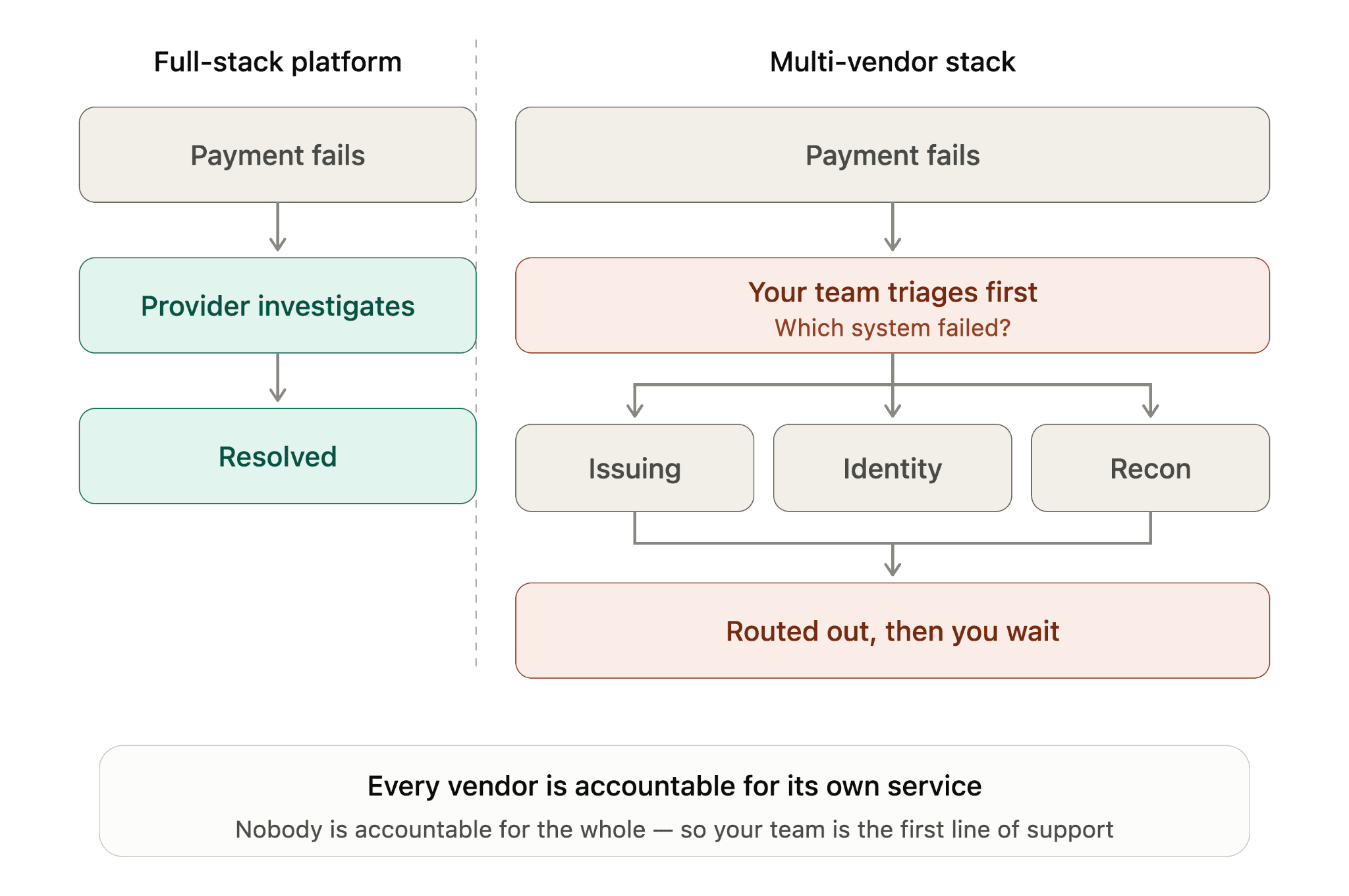
With a full-stack platform, one company does. In a multi-vendor setup your team investigates first, works out which system failed, then routes the ticket to whoever owns that piece. Each vendor is accountable for its own service. Nobody is accountable for the whole — and your team is the first line of support.
It's worth knowing which kind of company you're talking to. Licensed principals hold the permissions themselves. Program managers run the product on someone else's license — Mastercard's own partner program frames the role as holding the relationships with the issuer processor, sponsoring bank, network and card manufacturer. Point solutions do one thing well and expect you to connect it to everything else.
What happens if you choose the wrong provider
Switching provider is harder than choosing one, because the second time you do it with live money and real customers.
Balances have to move. Users often need verifying again, because identity records don't always transfer between providers. Cards get reissued, which means every cardholder gets a new number and every subscription stored against the old one breaks on the same day. Depending on the market, fresh regulatory approvals may be needed first.
Most teams budget a migration as an engineering project. It's a customer-experience event — and the users most likely to leave during one are the users who used the product most.
That's the real price of choosing wrong. Not the rate you agreed to, but how expensive it becomes to change your mind once you're live.
Five questions worth asking before you sign
1. What's your regulated footing in each market I need? Not how many licenses — what the structure is. Own license, locally licensed partner, or served from outside the region? Ask market by market.
2. What's my total cost per transaction across every supplier? Not their rate — everyone's, plus what connecting them costs your team.
3. Once live, how many separate contracts and systems am I holding? That's your real operating model.
4. When a transaction fails, who investigates first? If the answer is "your team," that's a permanent staffing cost.
5. What do I need to buy elsewhere to make this work? Good providers answer plainly.
The cheapest quote and the cheapest program are rarely the same company
None of those questions is technical. That's the point. The expensive mistakes in embedded finance aren't engineering mistakes — they're procurement mistakes, made in a spreadsheet a year before anyone notices, by comparing the one number easiest to compare.
You're not buying a rate. You're buying how much of this ends up your problem.
One platform, not a procurement project
MatchMove is a full-stack embedded finance platform built for companies operating across Asia. Accounts, card issuing, payouts, and KYC and KYB run on the same regulated platform, under a Singapore MAS Major Payment Institution license and through locally licensed institutions in the other markets it serves. Identity checks and reconciliation aren't separate vendors on separate contracts — they're already part of what you bought.
It's modular and API-first. Take the components you need, through integration across multiple APIs, and they work together because they were built together.
One platform. One contract. One compliance surface.
Frequently Asked Questions
Do I need a locally licensed provider to launch embedded finance in Asia?
You need a provider with regulated standing in each market you operate in — which is not the same as one that holds every license itself. Payment services, e-money issuance and card programs are regulated separately in each jurisdiction, and there is no regional passport equivalent to Europe's, so no provider is licensed everywhere. In practice, regional coverage comes from a combination of a provider's own licenses and partnerships with locally licensed institutions. Both are legitimate. What matters is that a regulated entity is accountable in each market, rather than the market being served from outside the region.
What's the difference between BaaS and embedded finance?
Banking-as-a-Service is the infrastructure layer — the accounts, payments, card issuing and licenses that make a financial product legally and technically possible. Embedded finance is what your customer experiences inside your product. A BaaS provider supplies the regulated capability; a program manager builds and operates the customer-facing product on top of it. Some companies do both, and asking which role a provider plays tells you where regulatory accountability actually sits.
What should I ask a BaaS or embedded finance provider before signing?
Beyond features and pricing: what regulated standing they have in each market you need, whether that comes from their own license or a locally licensed partner, what's included versus what you'll buy elsewhere, how many contracts you'll hold once live, your total cost across every supplier in the chain, and who investigates when a transaction fails.
How much does embedded finance cost?
Pricing models vary by provider, market, product mix and volume, so headline per-transaction rates aren't comparable on their own. The more useful basis for comparison is total cost of ownership: every supplier's fees across the chain, plus the engineering time to integrate them and the ongoing effort to keep them in agreement. A full-stack platform and a set of point solutions can quote similar rates and produce very different totals.
Sources: Monetary Authority of Singapore — Licensing for Payment Service Providers Bangko Sentral ng Pilipinas — National Retail Payment System Bank Indonesia — BI-FAST Mastercard — Engage Partner Program: Card Program Management