Embedded Finance: Why Companies Are Issuing Their Own Cards

Count how many times your users opened your app last month.
Now count how many times they opened their bank's.
It isn't close — and that gap is why companies like yours, who have nothing to do with finance, are partnering with financial institutions.
You spent years earning that attention. Embedded finance is something which will help you now get the most from it, and the most tangible place to start is usually a card.
What embedded finance actually means
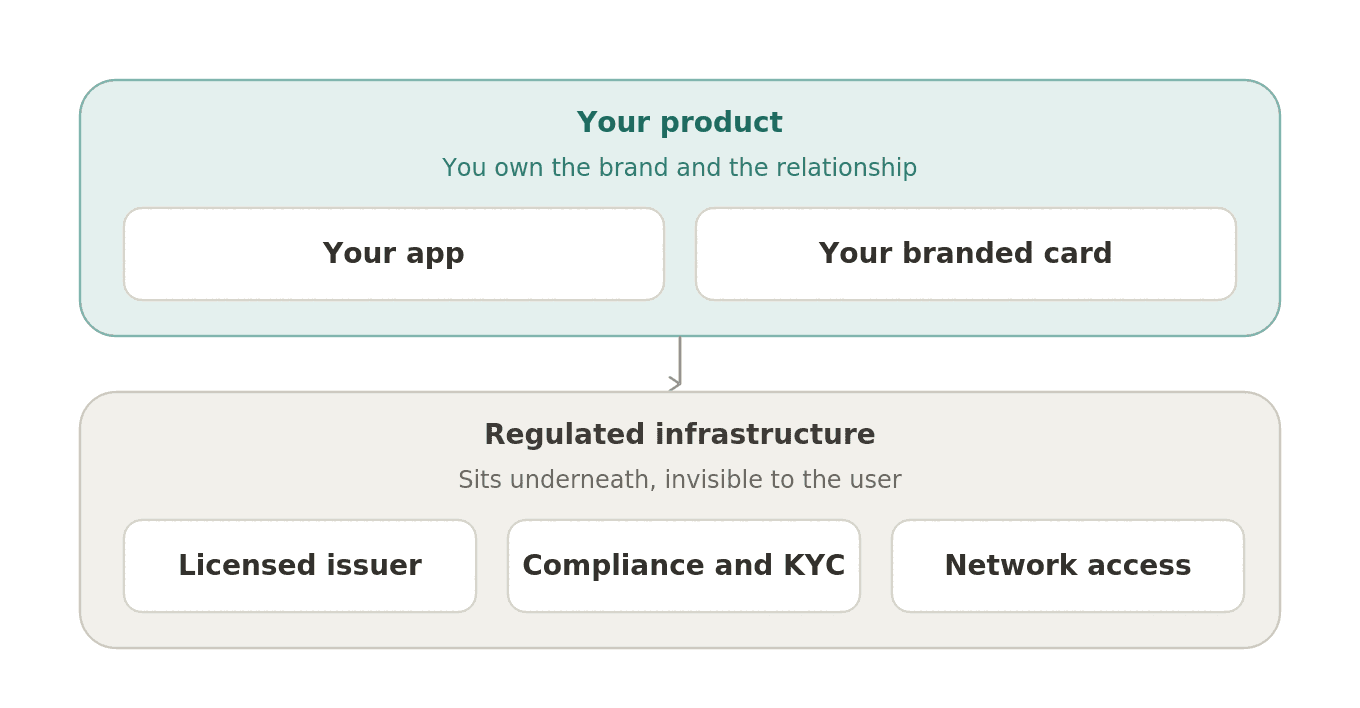
An awkward phrase for a simple idea: financial products offered inside a product/app that isn't a bank.
Paying in installments at checkout. A driver seeing earnings land in the app they already use for work. A balance you can spend without moving it somewhere first.
McKinsey describes it as financial products delivered by non-financial companies within their broader customer experience, with payments, accounts, cards and lending increasingly becoming part of digital platforms. (McKinsey, 2022)
Here's the part people get wrong: "your own card" doesn't mean you become the legal issuer. Your brand owns the experience and the program. A licensed institution sits underneath and carries the regulatory weight.
You provide the thing that can't be bought — the relationship with the user.
Why a card, specifically
1) It works beyond your app. No merchant has to integrate anything. The card works wherever the network is accepted, taking your product from inside your app to become valuable at the gas station.
2) It lives in someone's wallet. Your logo next to their bank's, physically or in their phone. No other software product gets that surface.
3) It turns a balance into something spendable. A balance in an app is an abstraction. The same balance on a card is lunch. Sounds trivial. Changes behavior.
What's actually in it for you
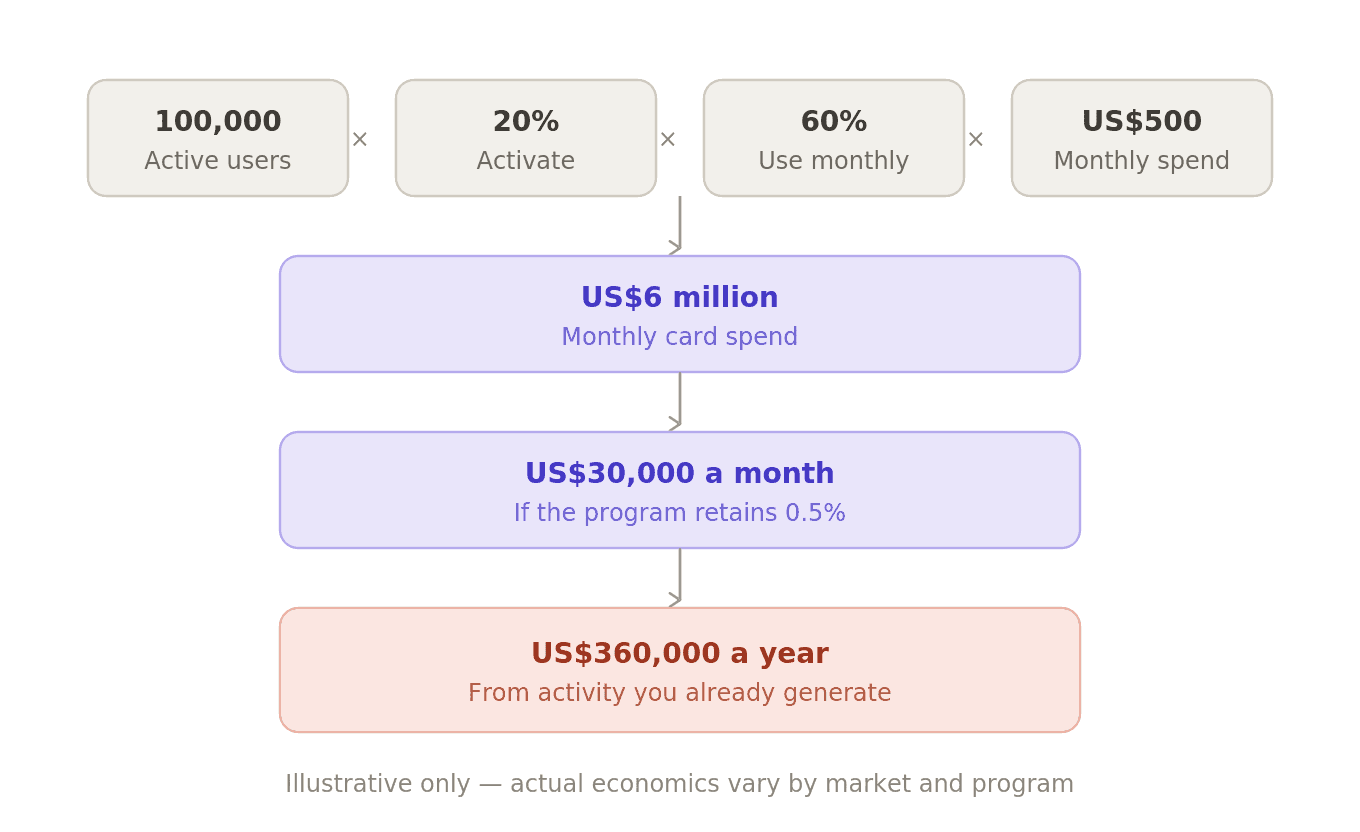
Economics around activity you already generate. Every card transaction generates interchange economics. How those are shared depends on the market, card type, transaction mix and the commercial structure of the program — but you'd be building a financial product on top of spending your platform already drives.
A reason to come back. A balance is unfinished business. People return to platforms where their money lives, not just platforms where they occasionally transact.
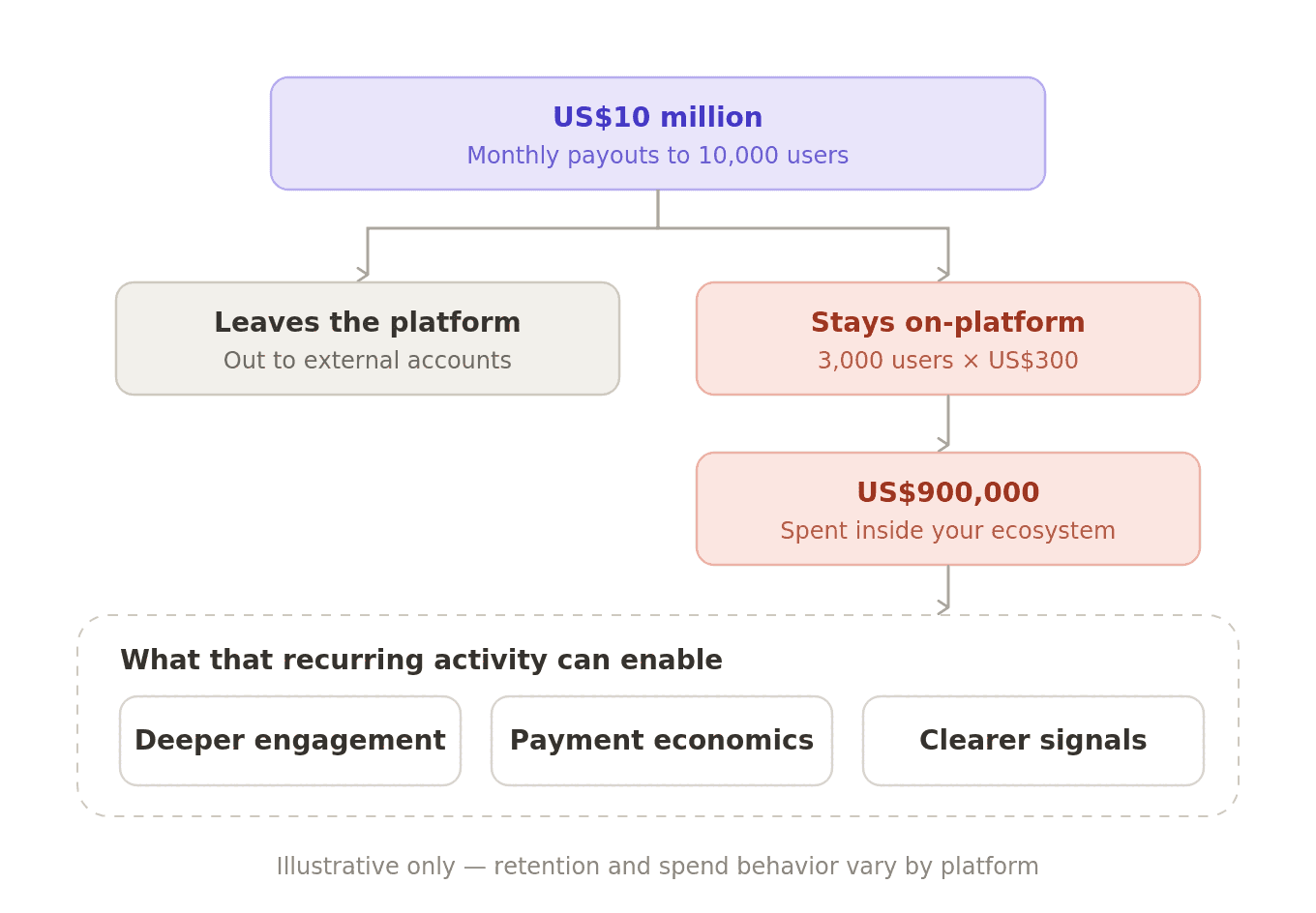
Money that stays in your ecosystem. If you already pay sellers, drivers, creators or employees, every payout to an outside bank account is where the financial relationship leaves your platform. A balance and a card keep more of it inside — and that recurring activity is what enables deeper engagement and a clearer view of what those users need next.
What has to be true, and who should carry it
Four things have to be true before a card program works. Only the first is yours alone.
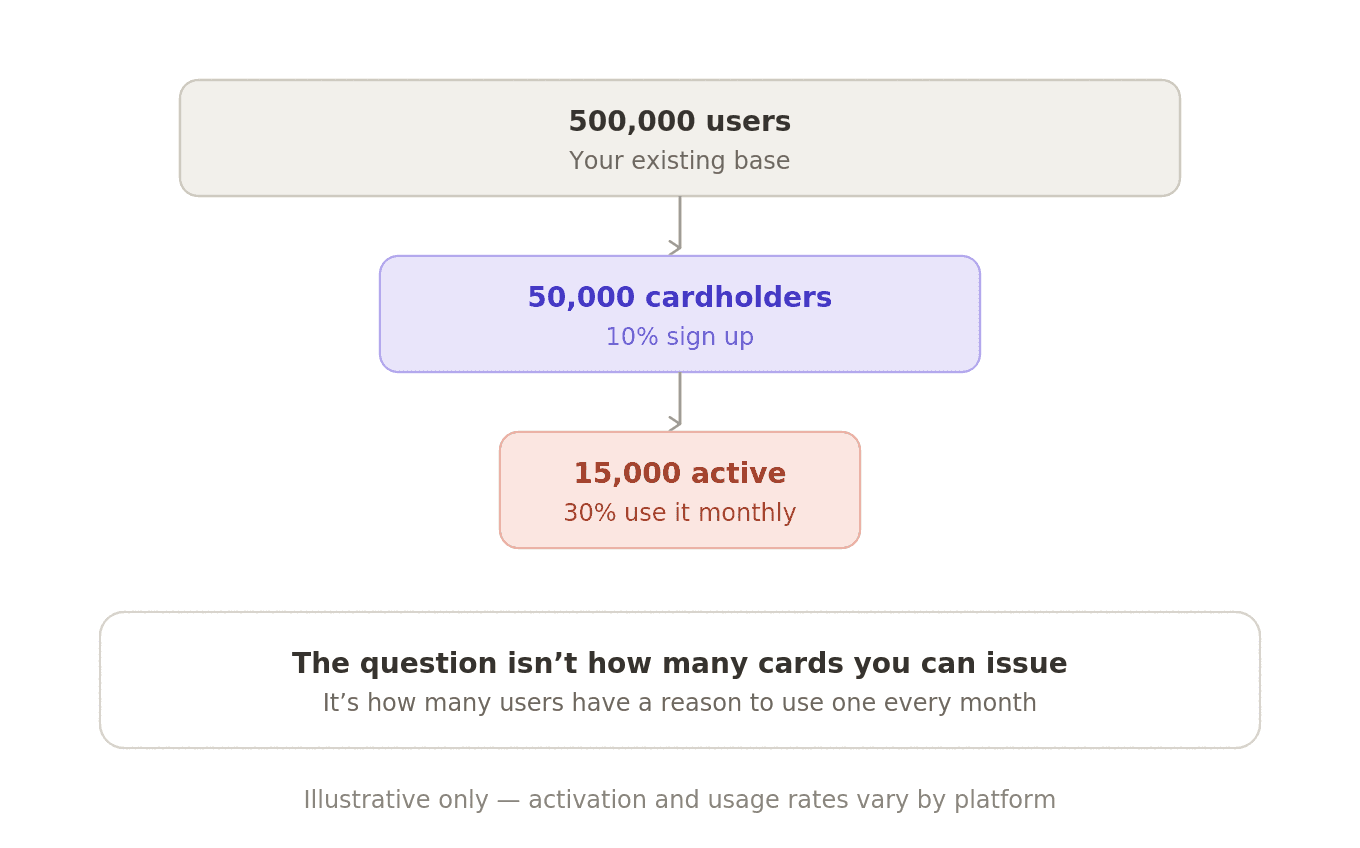
The card needs a job. This is the part no provider can solve for you. A card that exists because cards seem like a good idea becomes a loyalty card nobody activates. A card that exists because users need to spend money they earned on your platform has an obvious reason to be in a wallet.
Someone has to be regulated. It doesn't have to be you. Visa's guidance identifies a banking relationship, an issuer processor and typically a program manager as parts of a card-program ecosystem, and describes BIN sponsors as the issuing banks that own the BIN and take responsibility for cardholder funds, risk and local regulatory requirements. A real stack — but one you can inherit rather than assemble.
The money has to come from somewhere. Either users load their own balance, or the program is funded because you already owe them money. Both work, but the choice shapes your account structure and funding flows.
Cards are a product, not a feature. Cards get lost. Transactions get disputed. Someone will eventually call support. That operational layer exists whether you build it or your provider runs it — what varies is how much of it lands on your team.
What you buy matters as much as whether you build
Most companies don't decide to build everything. They decide to buy — and then buy in pieces. One vendor for card issuing. Another for identity checks. A third for reconciliation.
Two costs never show up in that comparison.
Connecting them is your job, and it never ends. Each vendor is responsible for its own piece. No one is responsible for making the pieces agree with each other. When your identity checks and your card system disagree about a user, your team is the one that sorts it out — and that doesn't stop after launch.
Each vendor prices its own slice of the same transaction. Individually every fee looks small. Stacked across the components of a card program, the total tends to become clear only after you've built it.
So ask any provider one question: when this is live, how many separate systems, contracts and integrations am I left holding? A regulated platform covering accounts, cards, payouts and identity together is a different proposition from three vendors and an integration project — even when the feature lists look identical.
Is this you?
It works when three things are already true: your users are engaged, money already moves through your platform, and the card has an obvious job. That's why marketplaces, gig platforms, payroll providers and business software are natural candidates — McKinsey identifies platforms with frequent digital customer interactions as particularly well positioned.
Think twice if users rarely return, or if the card's only purpose is rewards. Rewards are a reason to sign up, rarely a reason to stay.
The question isn't whether you can
Almost any company with a strong digital product and a real user need can issue cards today. The infrastructure exists and the technology is far easier to access than it once was.
The harder question is whether your users would use it — and you know your users better than any payments company ever will. That judgment is the part nobody can sell you.
The rest is a decision about who carries it.
Build the card program. Not the infrastructure underneath it.
Issuing cards is genuinely complex. The licensing, the partners, the compliance, the pieces that have to agree with each other — MatchMove handles all of it. Accounts, card issuing, payouts and KYC/KYB run on one regulated platform, through a single integration across multiple APIs, so a branded virtual or physical card program with spending controls starts with your product.
Frequently Asked Questions
What is embedded finance in simple terms? Embedded finance means offering financial products such as payments, accounts, cards or lending inside a non-financial product or platform. The customer uses the financial service where they already are, instead of moving to a separate banking app.
Can a non-financial company issue its own cards? Yes. A non-financial company can launch a branded card program through the appropriate regulated partners and card-scheme relationships. The company owns the customer experience and the brand, while regulated institutions and program partners provide the underlying issuing infrastructure.
What is BIN sponsorship? A BIN is a number range used to identify the issuer of a payment card. BIN sponsorship is an arrangement where a sponsoring financial institution provides access to a card network through its BIN and takes on defined issuing and regulatory responsibilities, including areas such as cardholder funds, risk and local regulatory requirements.
What's the difference between prepaid, debit and credit cards? A prepaid card spends funds loaded onto the card or its associated balance. A debit card spends funds linked to an account. A credit card provides access to a credit line the cardholder repays later. For platforms starting out, prepaid or debit models are often more natural, because credit introduces additional underwriting, funding and regulatory considerations.
Sources:
McKinsey — Embedded finance: Who will lead the next payments revolution?
Visa — What Partners Do I Need?
Visa Developer — VisaNet Connect: Issuing
Monetary Authority of Singapore — Financial Institutions Directory