


Two
ways to earn on money already moving
200+
countries reachable
Zero
bank charges on wallet payouts
At a glance
Vertical Global payroll, EOR and contractor-payment platforms
Products used Digital wallets · USD virtual accounts · white-label card issuance · global payouts · KYC/KYB · ledger
Markets Asia-Pacific, market-agnostic
Core change Payday ends inside the platform instead of outside it
Summary
Payroll and EOR platforms are serious software. Onboarding, contracts, compliance, benefits, time off, reporting — all in one place, the same in every market their clients hire in. Payments are one part of that, and they work. Bank integrations are live. Money arrives.
Then it is gone. Once it lands in a worker’s bank account the platform cannot see it, cannot control it, and earns nothing from it. It paid a fee to send it. The worker’s bank charged them to receive it.
Wallets and cards change where payday ends. Workers get an account and a card inside the platform’s product, in the platform’s brand. The spend data stays. The transfer can carry a margin. The card earns. And every market runs from one place.
What gets lost at payday
The transfer is given away. Payroll is the biggest sum of money in the business and most platforms take nothing on it. Cross-border companies charge for exactly this.
The data stops at the bank. The platform knows when a worker was hired, what leave they took and what they were paid. Once the money is sent, it knows nothing more. A bank transfer returns one thing: confirmation that it went out.
Control ends on arrival. Allowances, per diems, project budgets, benefits — all of it becomes ordinary cash the moment it lands. No categories, no limits, no policy.
It is the messy part. A bank here, a partner there, separate reconciliation for each. The rest of the product works the same way in every market. Payments do not.
Everyone pays a fee. The platform pays to send. The worker’s bank charges to receive and takes a cut on the exchange rate.
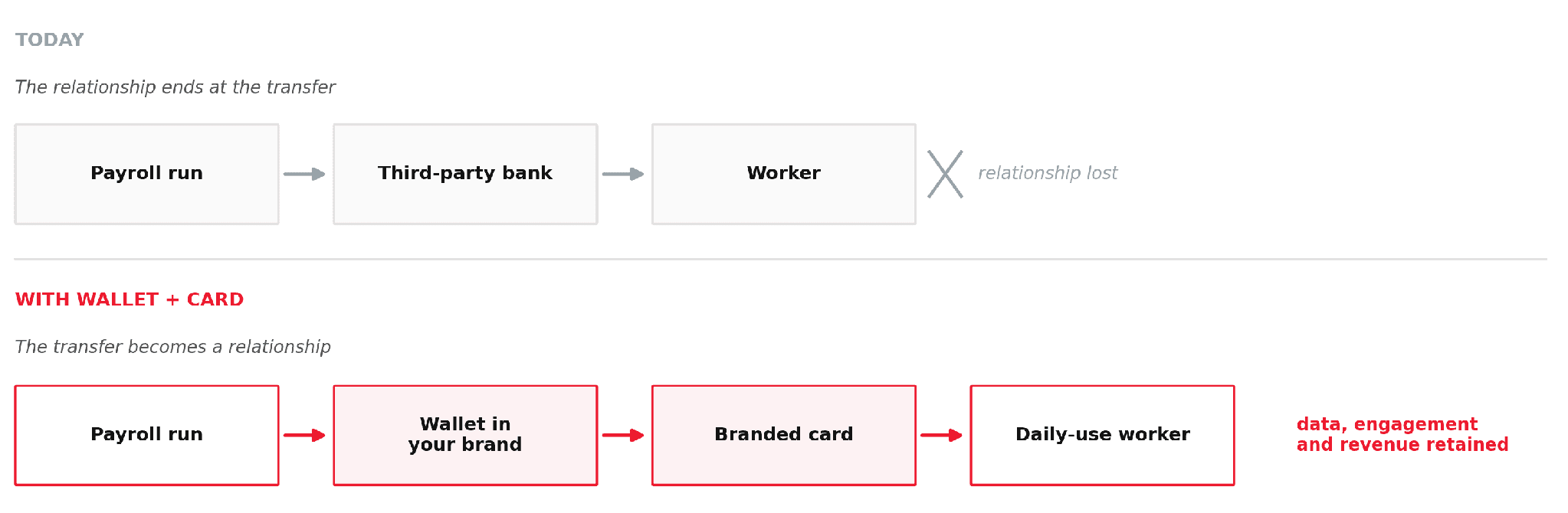
Where payday ends today, and where it ends with a wallet and card
Two ways to earn, not one
This is the part most platforms miss.
On the transfer. The platform sets its own markup on the fee and the exchange rate. It applies to payroll already being sent, so there is nothing to wait for. It works from the first payroll run.
On the card. When workers keep money in the wallet and spend on the card, the platform earns on that spend. Workers with limited access to USD banking have a reason to leave it there. Bigger over time, but only once people start using it.
The first is the safer bet and the quicker one. The second is where it gets interesting.
Why MatchMove
Most payroll platforms that go down this road assemble it: a payout provider, a card issuer, a KYC vendor, and a bank underneath. Four contracts, four sets of reporting, four versions of where the money is. Three things make this different.
One ledger, not four vendors. Most card platforms were built for cards alone. The moment payouts and card spend have to sit against the same balance, the ledger underneath was never designed for it, and reconciliation becomes a permanent engineering cost. MatchMove runs wallets, cards, payouts and KYC on one ledger. Pay arriving and pay being spent are the same record, not two systems to be matched.
A license, not a sponsor bank. Most issuers operate through sponsor banks, which means the program rests on a bank relationship the platform does not hold and cannot see. MatchMove Pay Pte Ltd is licensed directly by the Monetary Authority of Singapore as a Major Payment Institution. One counterparty, one contract, funds held at user level under a safeguarded fund, and a regulator a client’s compliance team will already recognize.
Built for distributed workforces. EOR platforms carry a long tail — five workers in one market, three in another. A payment build per market never pays back on numbers like that, so the smallest markets end up with the worst experience. Every worker is onboarded onto the same licensed platform and gets the same account and the same card, whether they are one of five or one of five thousand. Adding a market means adding workers, not building again.
Workers are onboarded onto the Singapore-licensed platform wherever they live, and the program runs under that license. For an established payroll platform this is not about solving a permissions problem — they already operate properly in their markets. It is about issuing accounts and cards without becoming a regulated financial institution to do it.
How it works
One integration, four things behind it:
Identity — digital, seamless KYC and KYB, with AML and sanctions screening running in the background.
Wallets and ledger — an account for each worker, a full record of every transaction, and limits set by account, category, day, month or transaction. Balances sit at user level under a safeguarded fund. Paired with a USD virtual account and enabled for cards, SWIFT and international transfers, the wallet works like a full bank account for the worker — which matters, because many workers cannot easily open a USD-denominated account of their own.
Cards — white-label Visa or Mastercard in the platform’s brand, virtual and physical, with Apple Pay and Google Pay.
Payouts — send to over 200 countries with live exchange rates and clear fees. A rate can be held for a set time before the money is committed. Most payments land same day or next.
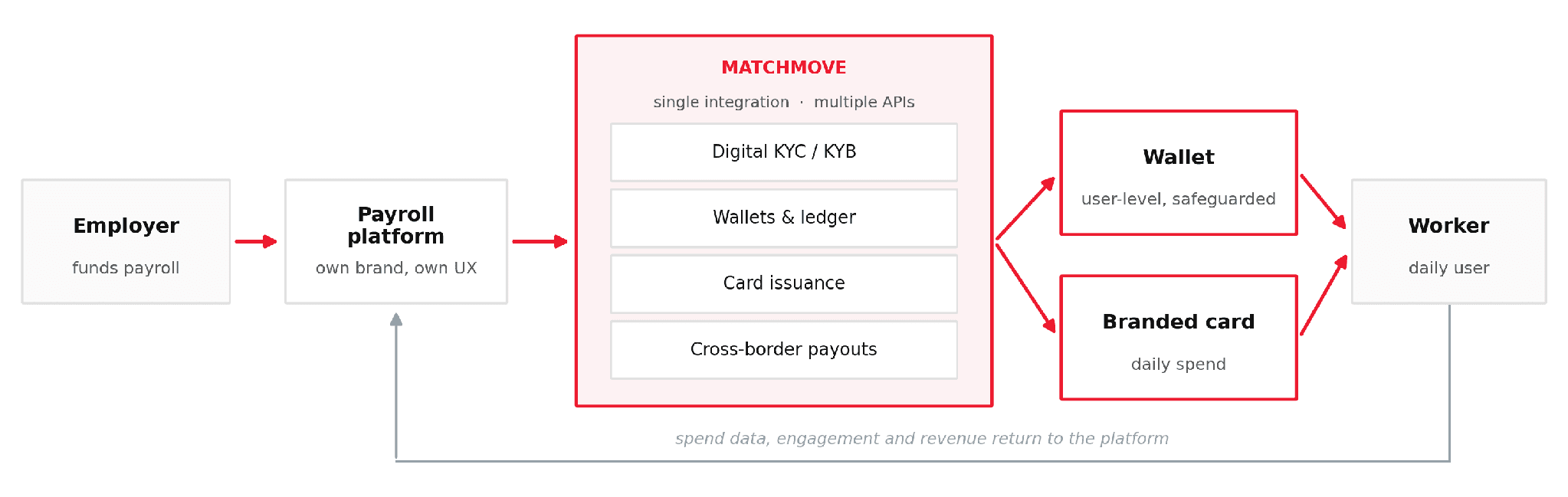
One way out; spend data, engagement and revenue back
Paying the exact amount
An employment contract says the worker gets a specific sum in their own currency. That means working backwards — the platform needs to know what it costs to land that exact figure on the other side.
Quotes run either way. Start from what is sent, or start from what the worker receives, with fees in or out. The worker gets the amount in the contract. The platform sees its real cost before committing.
The numbers
THE PAYROLL | |
Workers paid monthly | 10,000 |
Average monthly pay | US$1,500 |
Monthly payroll | US$15,000,000 |
EARNING ON THE TRANSFER | |
Markup on fee and exchange rate | 0.5% |
Monthly transfer margin | US$75,000 |
EARNING ON THE CARD | |
Share workers keep in the wallet | 20% |
Money sitting in wallets | US$3,000,000 |
Share of that spent on the card | 80% |
Card spend in the platform’s brand | US$2,400,000 |
Platform share of card spend | 0.8% |
Monthly card revenue | US$19,200 |
Total additional gross revenue, monthly | US$94,200 |
Illustrative only. The rates shown are examples — actual pricing is a commercial term set case by case.
Three things to know before starting
Pick the right account model. Cards and payouts running off one ledger calls for a standard funding wallet, funded ahead of each payroll run. Worth settling first, since it shapes everything built after it.
Sequence the two revenue lines. Transfer income starts immediately. Card income builds as workers start using the card. Both should not be modeled from day one.
Nothing else changes. The payroll engine, the client relationships and the compliance logic all stay where they are. The only thing that moves is where payday ends.
After launch
Program performance gets reviewed regularly, with optimization sorted by what pays back fastest. Fraud and risk rules are tuned as volume grows. Disputes, chargebacks, physical card production and items such as tokenization are handled as the card base grows.
What comes next
Once wallets and virtual cards are running, the same setup carries further — physical cards for in-store spending, and transfers home for workers supporting family in another country. Each one builds on what is already live.
Who is already doing this
A global remote-workforce payroll provider uses MatchMove to streamline payouts for remote teams and to offer payment methods that suit how remote workers actually want to be paid. A cross-border payroll and virtual-account platform in Asia runs named receiving accounts, prepaid cards and global payouts through one integration.
What MatchMove does not do
MatchMove does not calculate payroll. Gross-to-net, tax, statutory contributions and filings stay with the platform and its local partners.
MatchMove is not an Employer of Record and does not provide employing entities.
MatchMove does not lend. Credit products are built or plugged in by the platform.
That is on purpose. The platform keeps the expertise and the client relationships that make it hard to replace. MatchMove handles the licensed money infrastructure underneath, which is the slow and expensive part.
About MatchMove
MatchMove is an embedded finance and Banking-as-a-Service provider — “A Bank in Any App™”. MatchMove Pay Pte Ltd is registered in Singapore and licensed by the Monetary Authority of Singapore as a Major Payment Institution. PCI DSS 4.0.1 certified and authorized by Visa and Mastercard. MatchMove and its related entities operate in multiple countries worldwide.
Talk to the team. Thirty minutes to walk through what this would look like on your platform. Contact the MatchMove team at matchmove.com.

Power Your Growth with MatchMove
Seamlessly integrate payments, cards, and accounts into your platform with our proven API-first solution.